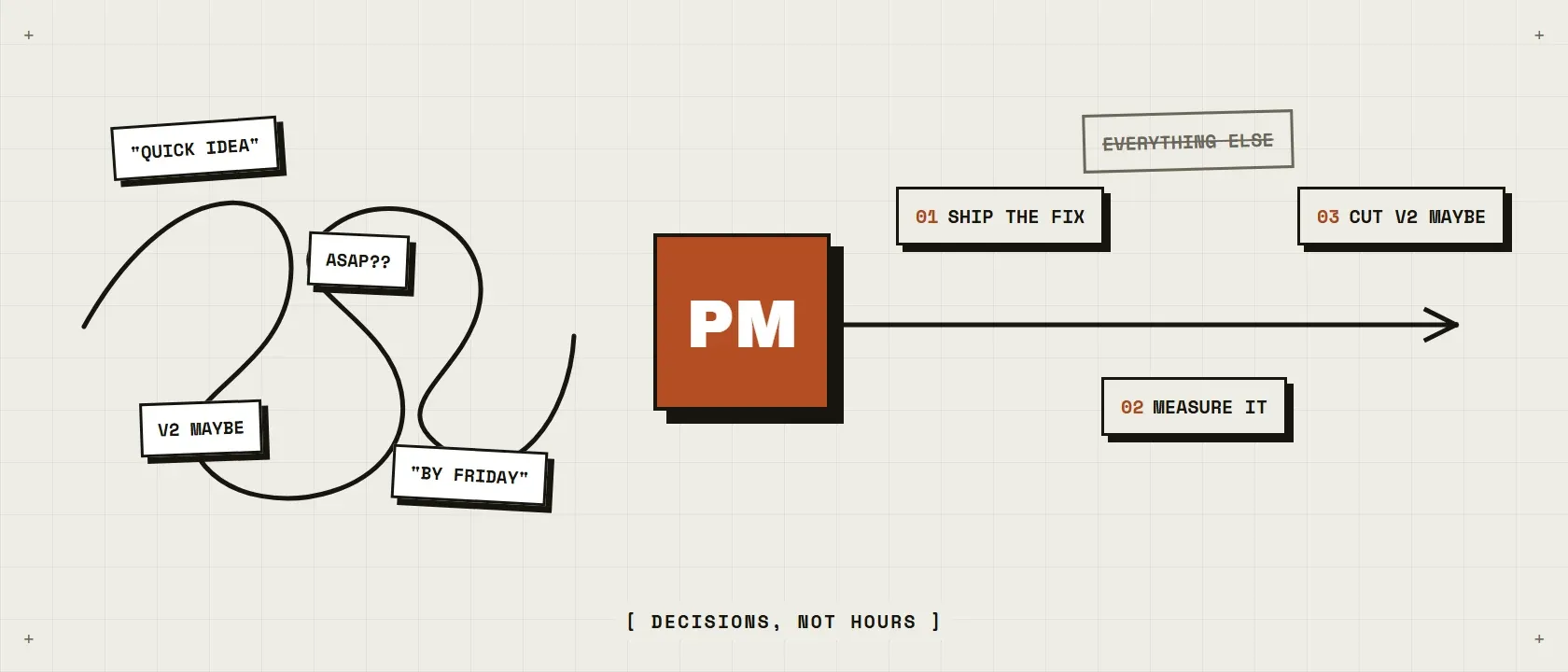
Somebody in your company is doing product management right now. If you cannot name who, it is you, at midnight, on top of your real job. The roadmap changes every time someone senior walks past it, engineers are guessing what matters, and the honest truth is that nobody owns the decisions. That is the problem this role exists for.
The short answer: a fractional product manager is a senior PM who owns your roadmap, priorities and releases part-time, typically 10 to 20 hours a week, for $3,500 to $12,000 a month depending on seniority and scope. You get the decisions of a senior hire without the $150,000+ salary, the five-month search, or the bet that you will still need them full-time next year.
What does a fractional product manager actually own?
The decisions. Specifically: what gets built, what gets removed, in what order, and why. In practice that means owning the roadmap, setting weekly priorities so engineers stop guessing, running releases, talking to your customers, and writing you an honest report on what moved. Day-to-day execution stays with your team; the fractional PM makes sure it points somewhere.
Products rarely fail because the engineering was bad. They fail because nobody decided what to build, what to cut, and in what order. I have run more than 200 customer interviews across the products I have managed, and the same lesson keeps landing: people do not want more features, they want the few they use to work. Someone has to be empowered to act on that, consistently, every week.
A fractional PM is not advice. It is ownership, part-time.
When does hiring one make sense?
When the product decisions have outgrown the time you can give them. The common triggers I see:
- The founder is the bottleneck. Every product question waits for you, and you are out of hours.
- The roadmap is whoever spoke last. Priorities change weekly and engineers have stopped believing them.
- Your PM just left. The backlog freezes while a five-month search runs.
- You raised money and now owe outcomes. Investors funded a roadmap, not a backlog.
- Features ship and nothing moves. Nobody is measuring, so nobody knows what worked.
And when it does not make sense: if you are pre-idea, product strategy is founder work and nobody can do it for you. If what you need is purely more hands to execute an already-clear plan, hire the hands.
What does a fractional product manager cost?
The market clusters around $5,000 to $12,000 a month for 10 to 20 hours a week; Go Fractional’s 2026 rate data puts the average at $148 an hour. Compare that to a full-time senior product hire at $150,000 to $280,000 a year plus the months of searching, and the fractional math is straightforward for a company that needs senior judgment but not yet forty hours of it.
My own pricing is published on this site, starting at $3,500 a month, because you were going to ask anyway. Deliberately under the big-market retainers: I am one person you hire directly, with nobody to onboard but me.
Fractional, interim, or full-time: which one?
They solve different problems, and the table is the fastest way to see it:
| Fractional | Interim | Full-time | |
|---|---|---|---|
| What it is | Ongoing part-time ownership | Holding the seat for a fixed stretch | A permanent hire |
| Best when | Decisions outgrew your time | Your PM left, search is running | The product needs 40 hrs/week of ownership |
| Cost | $3,500 to $12,000/mo | Similar, fixed term | $150,000+/yr plus the search |
| Ends with | Extension or a clean handover | Your next PM inheriting real notes | Payroll |
The honest sequencing for most growing companies: fractional or interim now, full-time when the workload proves it. A good fractional PM should help you make that hire, not prevent it.
What should the first month look like?
Listening, measuring, and one visible subtraction. In my first weeks I interview customers, read the numbers instead of the opinions, and almost always find a backlog that needs cutting more than it needs adding. Then priorities get set, a release goes out, and you get a report that says what moved and what did not, in plain language.
What the first month should not look like: a strategy deck, a process overhaul, or a request for three more tools. Those are consultant reflexes. The job is decisions and shipping.
How do you judge whether it is working?
By what shipped, what got decided, and what the numbers did, inside the first two months. Releases going out on a cadence. A roadmap with reasons attached that survives contact with a senior person walking past it. Metrics moving: in my own work, A/B tests have lifted click-to-buy conversion by 70% and more, more than once, and I put numbers like that in monthly reports because they are the only honest scorecard.
If you cannot point at decisions made and things shipped after eight weeks, it is not working, and a good fractional PM will say so themselves.
The takeaway: fractional product management is senior ownership of your product decisions, part-time, at a price a growing company can actually justify. It fits when decisions have outgrown your hours, and it should end either in an extension that is earning its keep or a clean handover to the full-time hire it helped you define.
Sometimes the product in question is the website itself, and then the budget conversation starts elsewhere: what a WordPress website really costs covers that math. And if your roadmap is the thing keeping you up, tell me where it is stuck. If you do not need me yet, I will tell you that too.
Frequently asked questions
How many hours a week does a fractional product manager work?
Typically 10 to 20 hours a week, though the honest unit is decisions, not hours. A senior PM can set priorities, unblock engineers and run a release cadence in 10 focused hours. What you are buying is judgment applied regularly, not presence in meetings.
Is a fractional product manager worth it for an early-stage startup?
If you have a product and users, usually yes: it is senior product judgment at a fraction of a full-time cost. If you are pre-idea, no. Deciding what business to start is founder work, and no PM can do it for you.
What is the difference between a fractional product manager and a consultant?
A consultant advises and leaves you a document. A fractional product manager owns outcomes inside your team: the roadmap, the priorities, the releases. The deliverable is decisions made and things shipped, not recommendations.
How long does a fractional product management engagement last?
Three to six months is typical. Long enough to fix the decision-making and ship real releases, short enough to stay honest. A good engagement either extends because it is visibly working or hands over cleanly to a full-time hire.