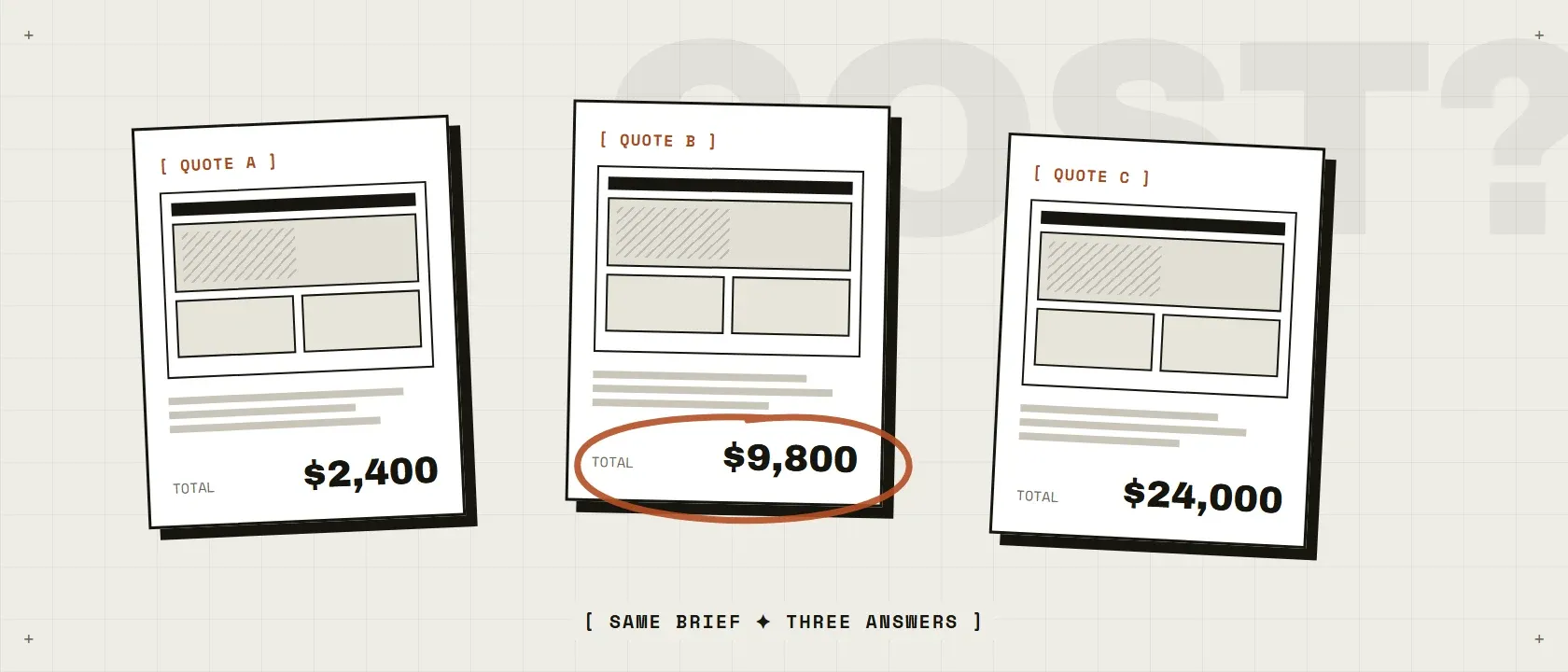
Ask three agencies to quote the same website and you will get three numbers that differ by a factor of ten. None of them are necessarily lying. They are answering different questions. This post gives you the real ranges, and then teaches you the four decisions that actually set the price, so the next quote you read makes sense.
The short answer: a professionally built WordPress website costs $3,000 to $15,000 for most small businesses in 2026. DIY runs $100 to $200 a year, freelancer builds $500 to $5,000, and complex or enterprise projects go from $35,000 up. The spread is not margin. It is decisions that have not been made yet.
Why do WordPress quotes differ by 10x?
Because “a website” is not a product. It is a bundle of decisions that have not been made yet, and each quote is a different set of guesses about them. When a brief leaves the questions open, every agency answers them differently and prices them differently. Four decisions do most of the damage:
- Design. A customized off-the-shelf theme, or custom design from a blank page. This choice alone can swing the budget 5x.
- Development. Templates and standard plugins, or custom functionality. Count the features that do not exist in any plugin yet. Those are the expensive ones.
- Content. Copy, photography, migration of your old material. The bucket everyone forgets, and the most common reason launches slip.
- Running costs. Hosting, licenses, maintenance, updates. A website is a subscription, not a purchase. Ask for the yearly number up front.
A low quote usually means the agency answered every open question with the cheapest option. A high quote often means they priced in the risk of not knowing.
What does a WordPress website cost to build?
Most small business sites land between $3,000 and $15,000 when built professionally. Public pricing guides from WebFX, Elementor and others put the full field wider, and the wide field is worth seeing in one table:
| Who builds it | Typical cost | Best for |
|---|---|---|
| You (DIY) | $100 to $200 first year | A business card online, tested cheaply |
| Freelancer | $500 to $5,000 | Standard sites with a clear, fixed scope |
| Small studio | $3,000 to $15,000 | Businesses whose site must win customers |
| Agency | $10,000 to $35,000+ | Complex builds, integrations, e-commerce at scale |
The price of a website is the price of the decisions in it. Fewer open decisions, tighter quotes.
Two honest notes from my side of the counter. First, the middle of the market is where most owners should be, and it is also where comparing quotes matters most, because $4,000 and $12,000 can describe the same site with different unmade decisions. Second, a beautiful site that does not load or sell is expensive at any price, which is why speed belongs in the brief (more on that in why WordPress sites get slow).
What does a WordPress website cost to run?
Plan for 10 to 20% of the build cost every year, and treat any quote without a yearly number as incomplete. The pieces:
- Hosting. $5 to $15 a month shared, $25 to $80 managed. This is the one line where cheap actively hurts, because hosting sets your speed floor.
- Domain. $10 to $20 a year. The boring one.
- Licenses. Premium plugins and themes renew yearly, commonly $50 to $300 total. Unpaid licenses stop updating, and outdated plugins are how sites get hacked.
- Maintenance. Updates, backups, security monitoring. $20 to $200 a month bought as a service, or your own evenings.
I spent years inside WordPress products used on millions of sites, and the pattern never changed: sites do not fail on launch day. They fail eighteen months later, quietly, when nobody is updating anything. The running budget is not an upsell. It is the part that keeps the launch worth what you paid.
Where is it safe to save money?
Wherever a decision genuinely does not matter for your business yet. A customized quality theme instead of custom design saves thousands and most visitors will never know. Launching with five pages instead of fifteen saves money and usually improves the site, because every page you cut is one you no longer have to write, maintain, or keep honest. Stock photography on interior pages is fine. Your own phone photos of real work often beat it.
The bravest budget decision is usually subtraction. I have run more than 200 customer interviews across the products I have managed, and people keep teaching me the same lesson: they do not want more pages, they want the few they use to work.
Where does saving money backfire?
On anything that compounds. Cheap hosting costs you a little every single visit. A bargain page builder locks your content into a tool that may be abandoned next year. Skipping content budget means the site launches with placeholder text that becomes permanent. And the classic: hiring the cheapest bidder, then paying a second time for the rebuild, which makes the cheap site the most expensive one you ever bought.
If the site IS your product, meaning you are budgeting signups and revenue rather than a brochure, you are pricing a build, not a website. That math is different, and it is the world I work in as a product manager: what a fractional product manager actually does covers it.
How do I compare quotes that look nothing alike?
Make them answer the same four questions, in writing: what design approach, what custom functionality, who produces the content, and what the yearly running cost is. Any professional can answer in one page. Once quotes answer the same questions, they become comparable, and the price differences start meaning something: this one includes content, that one assumed you write it.
The takeaway: the ranges are real ($3,000 to $15,000 for most professional small business sites), but the number that matters is the one attached to answered questions. Get the four decisions in writing, get the yearly cost in writing, and the 10x mystery disappears.
If you are staring at quotes right now and want a second pair of eyes from someone who has been on both sides of them, tell me where you are stuck. Sometimes the honest answer is that the cheapest quote is fine, and I will say so.
Frequently asked questions
Is WordPress itself free?
Yes. The WordPress software is free and open source. What costs money is everything around it: hosting, a domain, premium plugins or themes, and the hours of whoever builds and maintains the site. That is why “WordPress is free” and “my WordPress site cost $8,000” are both true.
How much does a WordPress e-commerce site cost?
More than a brochure site, usually $800 to $10,000+ to launch depending on catalog size and custom features, plus payment processing fees of roughly 2.9% + $0.30 per transaction. Product data entry is the cost everyone forgets to budget.
How much does WordPress maintenance cost per year?
Plan for roughly 10 to 20% of the build cost per year. In practice that is $400 to $1,200 a year for a typical small business site covering updates, backups, security and plugin licenses, and more if someone actively improves the site rather than just keeping it alive.
Can I build a WordPress website myself?
Yes, for $100 to $200 in the first year using shared hosting and a good theme. It is a real option when your site is a business card. The moment the site needs to win customers, the honest question is whether your time is cheaper than a professional build.